
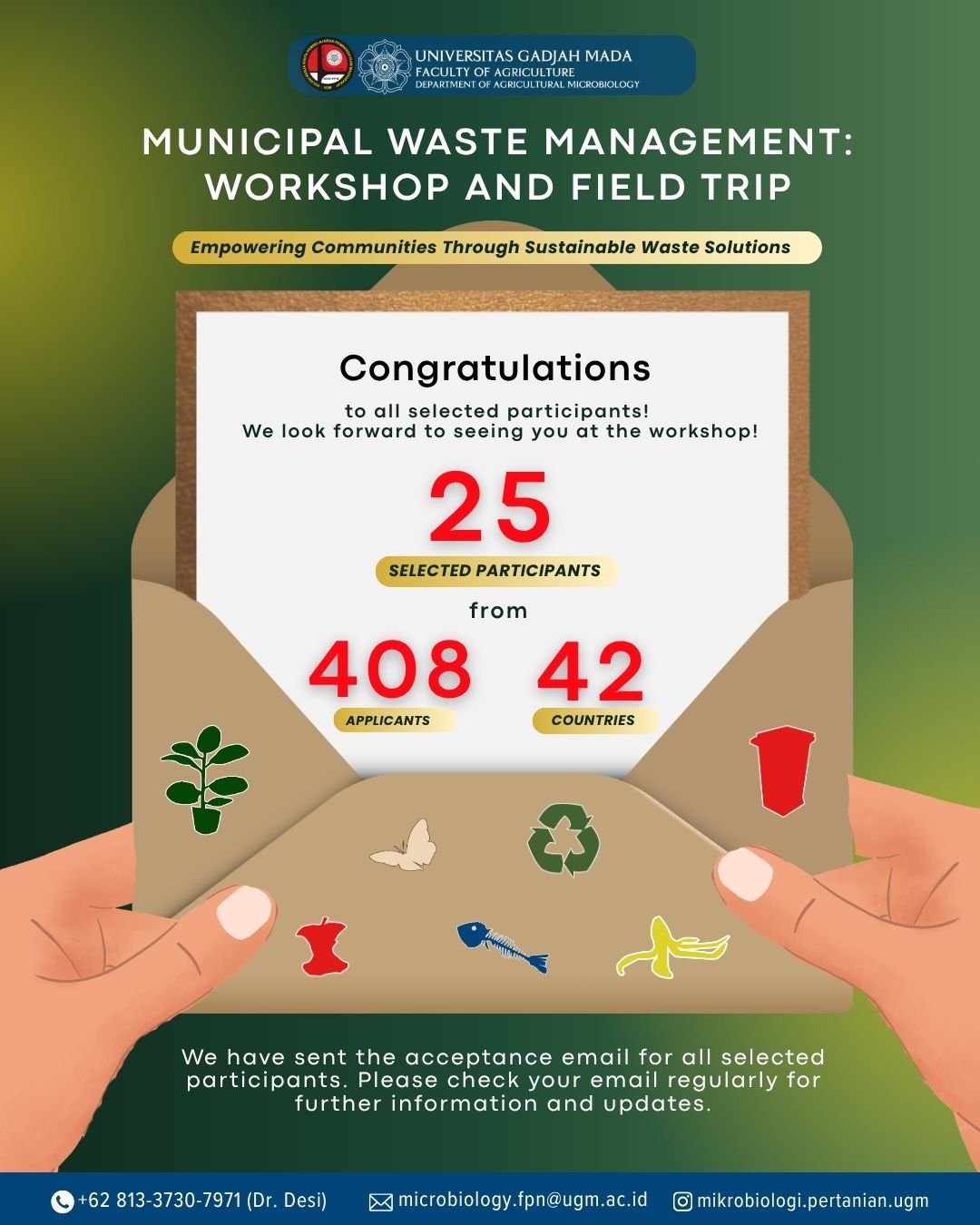
The Department of Agricultural Microbiology, Faculty of Agriculture, Universitas Gadjah Mada (UGM), has attracted significant international attention through its Municipal Waste Management: Workshop and Field Trip – Empowering Communities Through Sustainable Waste Solutions. Scheduled to take place from 20–26 July 2026, the program received an overwhelming response, attracting 408 applicants from 42 countries, with only 25 participants selected through a highly competitive selection process.
The remarkable level of interest reflects the growing global concern for sustainable municipal waste management and the implementation of environmentally responsible solutions. Participants were selected based on their academic background, professional experience, motivation, and potential to apply the knowledge gained in their respective countries.
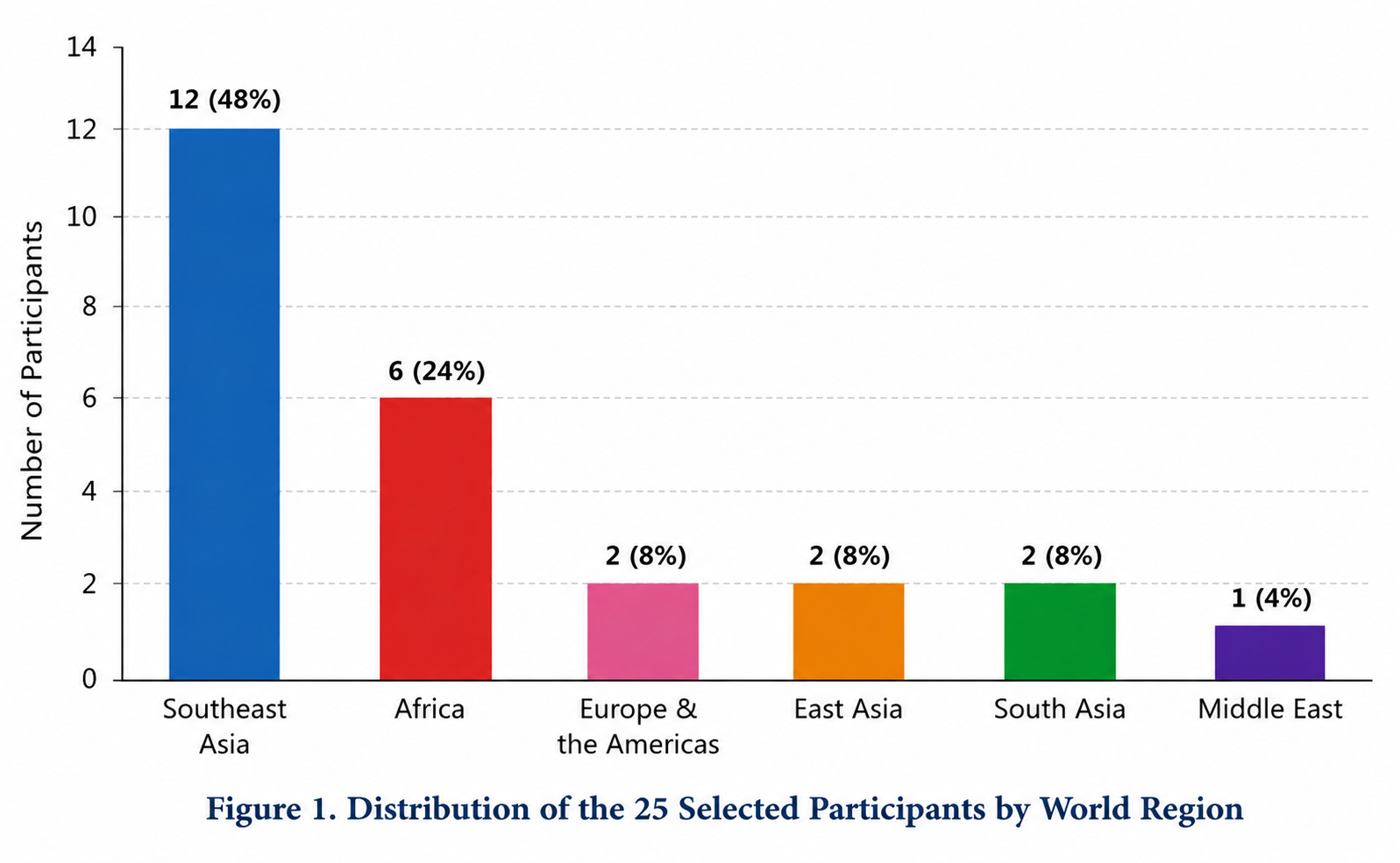
Among the selected participants, Southeast Asia accounted for the largest regional representation with 12 participants (48%), followed by Africa with 6 participants (24%). Europe and the Americas, East Asia, and South Asia each contributed 2 participants (8%), while the Middle East was represented by 1 participant (4%). This regional diversity highlights the workshop’s role as an international platform for knowledge exchange and cross-cultural collaboration in sustainable waste management.
The applicant pool was dominated by undergraduate students (49.3%), followed by master’s students (28.0%) and doctoral students (8.5%). The program also attracted academic staff, researchers, professionals, and government officials, demonstrating that sustainable waste management is a multidisciplinary issue requiring collaboration across sectors.
In terms of country representation, the Philippines accounted for the largest share of applicants (31.8%), followed by Pakistan (14.3%), Cambodia (9.0%), Malaysia (4.7%), Nigeria (3.8%), Sudan (2.6%), Vietnam (2.6%), The Gambia (2.6%), Yemen (2.3%), and China (2.0%). Applicants from 32 additional countries (24.2%) further contributed to the program’s broad international participation, bringing the total number of represented countries to 42.
The workshop has been designed to provide participants with a comprehensive understanding of sustainable municipal waste management through a combination of expert lectures, interactive discussions, case studies, and field visits to waste management facilities in the Special Region of Yogyakarta. Participants will explore community-based waste management practices, circular economy approaches, the application of microorganisms in organic waste treatment, and innovative technologies that support environmentally sustainable waste management systems.
Through this program, the Department of Agricultural Microbiology aims to strengthen international academic networks while fostering collaboration in developing sustainable and locally adaptable waste management solutions. The diversity of participants is expected to enrich discussions, encourage the exchange of experiences, and establish long-term collaborations among academics, practitioners, policymakers, and researchers from around the world.
This initiative also reflects the Department’s commitment to supporting the United Nations Sustainable Development Goals (SDGs), particularly SDG 4 (Quality Education) by providing high-quality international learning opportunities, SDG 11 (Sustainable Cities and Communities) by promoting sustainable municipal waste management, SDG 12 (Responsible Consumption and Production) through circular economy principles and responsible waste management, SDG 13 (Climate Action) by encouraging strategies to reduce the environmental impacts of waste, and SDG 17 (Partnerships for the Goals) by strengthening international collaboration among universities, governments, industry, and professionals.
With participants representing 42 countries across six world regions, the workshop is expected to serve as a valuable international platform for exchanging knowledge, sharing best practices, and promoting innovation in sustainable municipal waste management. The Department of Agricultural Microbiology, Universitas Gadjah Mada, hopes this initiative will contribute to building more resilient, environmentally responsible, and sustainable communities worldwide.