
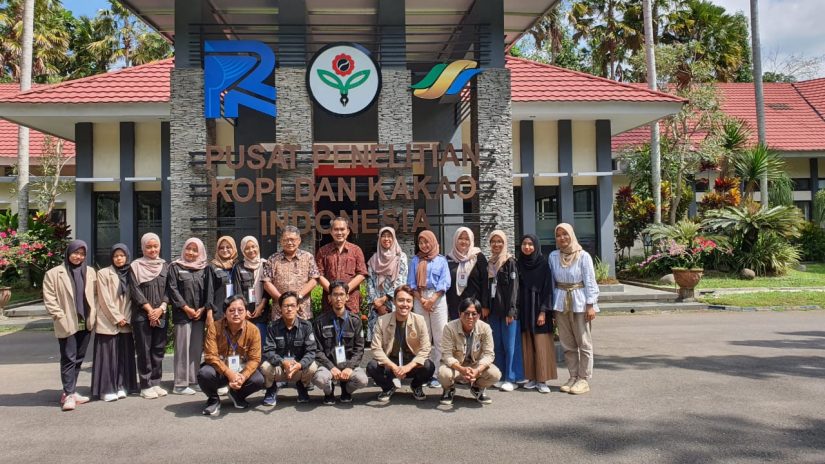
Students from the Department of Agricultural Microbiology, Fika Tri Andaini (2020) (Fika) and Nur Afni Febriyani (2020) (Afni), had the opportunity to participate in the Merdeka Belajar Kampus Merdeka (MBKM) program in the form of Internship Learning Activities (MBKM-Internship) at the Coffee and Cocoa Research Center (PUSLITKOKA) from February 6, 2023, to June 16, 2023, precisely in their 5th semester. During their MBKM at PUSLITKOKA, Fika was placed in the Plant Disease and Pest Laboratory, while Afni was in the Plant Protection Laboratory. The MBKM-Internship program undertaken by Fika and Afni was equivalent to more than 20 credits in one semester. The courses equivalent for Fika and Afni had some differences, depending on the laboratory where they were placed. For Fika, there were 11 equivalent courses, including Microbial Development, Production, and Utilization; Soil Microbes; Pest and Disease Control; Development of Biological Agents; Identification of Pests and Diseases; Processing of Agricultural/Plantation Products; Quality Control and Quality Assurance of Agricultural/Plantation Products; Managerial Behavior; Field Work (KL); Seminar; and Leadership, while for Afni, there were also 11 equivalent courses, but there were 5 courses different from those taken by Fika, including Communication Skills; Processing of Agricultural/Plantation Land Fertility; Development, Production, and Utilization of Beneficial Microbes; Fundamentals of Coffee Biotechnology; and Fundamentals of Cocoa Tissue Culture.
Fika and Afni chose to participate in the MBKM-BKP Internship program because they could gain learning experience outside of campus in research fields according to the actual work environment while also being able to convert Field Work and Seminar courses. According to Fika and Afni, the MBKM registration process, such as document management, could be easily followed because the academic faculty provided guidance for each process. However, there were also obstacles during the MBKM registration process, namely determining the list of courses to be converted. This obstacle could be overcome by regularly consulting with the Program Study Chair. During the MBKM process at PUSLITKOKA, Fika and Afni felt more flexible in completing courses compared to regular (Non-MBKM) courses because MBKM, which is based on the concept of learning while working, allowed them to directly apply the theories taught on campus. They also frequently engaged in discussions to discuss theories with workers. Beyond the implementation of MBKM activities, they also gained many soft skills, such as adapting to survive in less modern areas outside the city, polite and assertive communication skills with workers, and problem-solving abilities given in the form of tasks by supervisors as well as small problems encountered during adaptation outside MBKM.
This synergy is a strong evidence to achieve the goal of SDG 4: Quality Education and SDG 17: Partnerships for the Goals.