
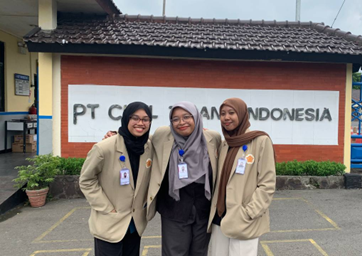
The Fieldwork Program (Kerja Lapangan/KL) for students of the Department of Agricultural Microbiology was carried out from January 2 to February 2, 2025, at PT Cheil Jedang Bio Jombang. This program served as an opportunity for students to implement the theories learned in class within a real industrial setting. During this period, three students—Evita Nuraini, Farah Nabila Pasya, and Amanda Amel Widyaningrum—participated and gained highly meaningful experiences.
Throughout the KL activities, Evita and her two colleagues acquired valuable technical and non-technical insights. From a technical perspective, they were able to directly observe and understand the complete workflow of the industrial wastewater treatment process. The students were also involved in sampling procedures, measuring water quality parameters such as DO and pH, and performing various laboratory tests including COD and ammonia analysis.
Evita described her experience as something that broadened her understanding significantly. “I only truly realized how complex industrial processes are after seeing them firsthand. Every stage has its own challenges and requires a high level of precision,” she explained. She further added that the experience offered a new perspective on the importance of accuracy and coordination. “We learned that even small details can greatly impact industrial operations,” she continued.
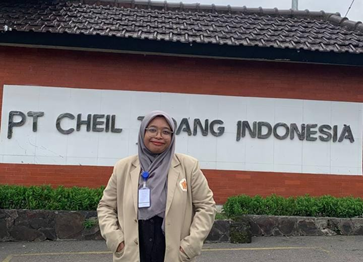
Beyond the technical aspects, the fieldwork also exposed Evita, Farah, and Amanda to the real dynamics of industrial workplace culture. They observed how interdepartmental coordination operates, how communication plays a crucial role in ensuring smooth processes, and how operators and technicians carry out their duties professionally. Direct interaction with experienced industry workers provided practical insights that could not be gained solely through classroom learning.
For students, this KL program offered an important opportunity to gain deeper understanding of industrial processes, enhance practical skills, and become familiar with real work environments. Evita also shared advice for future KL participants: “Come prepared and don’t hesitate to ask questions. Make the most of every opportunity to learn because this experience is extremely valuable for your future career.”
This Fieldwork Program also supports the Sustainable Development Goals (SDGs), particularly SDG 4: Quality Education, by providing contextual learning experiences that strengthen students’ understanding through direct industrial practice. In addition, it contributes to SDG 6: Clean Water and Sanitation through student involvement in industrial wastewater treatment processes, which aligns with efforts to maintain environmental quality. This program serves as an important step in preparing competent, environmentally aware graduates who are ready to contribute to sustainable development.