
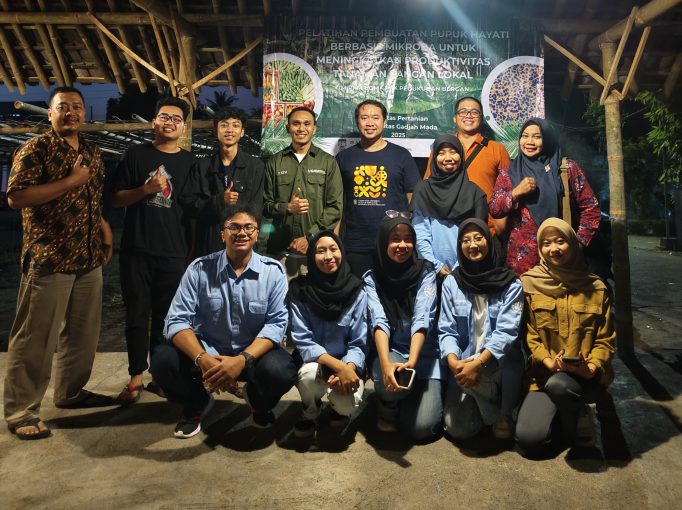
In support of food security and sustainable farming practices, the Community Service (PKM) team of the Faculty of Agriculture, Universitas Gadjah Mada (UGM) organized a training on “Microbial-Based Biofertilizer Production” for the women’s community group (PKK) of Pedukuhan Bergan, Wijirejo Village, Bantul Regency on Sunday, July 20, 2025. The activity took place from 3:00 p.m. to 6:00 p.m. WIB, involving lecturers, students, and local residents in a spirit of collaboration and enthusiasm.
Bantul is one of the food production centers in the Special Region of Yogyakarta (DIY), currently facing serious challenges related to the sustainability of agricultural land. Data from the local Agriculture Office shows a decline in soil fertility due to the intensive use of chemical fertilizers over the past two decades. This condition makes biofertilizer innovations increasingly relevant to support agricultural productivity while reducing dependence on subsidized chemical fertilizers.
In response to this issue, the PKM UGM team, led by Yumechris Amekan, S.Si., M.Biotech., Ph.D., together with Faculty of Agriculture lecturers —Agung Dian Kharisma, S.Pd.Si., M.Biotech., Ph.D., Nur Akbar Arofatullah, S.P., M.Biotech., Ph.D., Dr. Najmu Tsaqib Akhda, S.P., M.A., Susanti Mugi Lestari, S.P., M.Si., Ph.D., and Dr. Adyatma Irawan Santosa, S.P., M.Sc.— as well as four students from the Department of Agricultural Microbiology (Severinus Adrian Maitri, Najmaturrahma Baskoro, Tsania Putri Soflyna Azzahra, and Praharsiwi Nisa Az Zahro) actively initiated this activity. By utilizing local microbes to produce biofertilizers, the training aimed to provide simple, affordable, and environmentally friendly alternatives for farmers and household-scale gardeners.
The program began with an introduction highlighting the urgency of biofertilizer development. The presentation session offered a comprehensive understanding of the concept of biofertilizers, the benefits of soil microbes, and their relationship to ecosystem sustainability. Participants were then engaged in hands-on practice to produce biofertilizers. They were introduced to the materials, tools, and step-by-step procedures for making fertilizers based on Bacillus sp. cultures, which are proven to enhance root growth, improve soil fertility, and naturally control plant diseases.
The training atmosphere was lively and interactive. Participants actively raised questions related to home gardening as well as agricultural land issues. “We are glad to learn how to make biofertilizers. By using local materials, we can reduce costs while keeping the soil fertile,” said Mrs. Risti, one of the PKK participants from Pedukuhan Bergan.
In the closing session, Yumechris Amekan emphasized the importance of program continuity. “The participants showed strong learning enthusiasm, which aligns with the expected outcomes of this activity. In the future, we can organize follow-up programs related to practical solutions for challenges in honey pumpkin cultivation in Pedukuhan Bergan. The problem lies in the good initial yields, but declining quality during seed propagation. This can be addressed through additional workshops in collaboration with the Department of Agronomy,” he explained. The activity also provided students with valuable fieldwork experience. Their involvement went beyond technical assistance, serving as a real-life application of agricultural microbiology knowledge within the community. This is in line with the spirit of the Three Pillars of Higher Education (Tridarma Perguruan Tinggi), particularly community service, and represents a form of experiential learning that fosters young generations’ awareness of sustainable agriculture.
Through this training, the community of Pedukuhan Bergan is expected to become more independent in managing family farming. Food production will become healthier, while production costs can be reduced by utilizing local inputs. Beyond that, this initiative also strengthens collective awareness of the importance of maintaining soil fertility and environmental health. The activity was not only a form of knowledge transfer but also a tangible scientific contribution toward achieving Sustainable Development Goal (SDG) 2: Zero Hunger and SDG 15: Life on Land.
Authors: Severinus Adrian Maitri & Tsania Putri