The establishment of a DNA Synthesizer at the Department of Agricultural Microbiology, Faculty of Agriculture, Universitas Gadjah Mada (UGM), represents a significant step in strengthening the university’s research infrastructure. This initiative has been spearheaded by Nur Akbar Arofatullah, S.P., M.Biotech., Ph.D., who has played a key role in advancing molecular biology and biotechnology research within the department. Under his leadership, the Department of Agricultural Microbiology continues to expand its research capacity by providing cutting-edge facilities that support the development of microbiology, molecular biology, agricultural biotechnology, and related scientific fields.
SDG 9: INDUSTRY INNOVATION AND INFRASTRUCTURE
International academic engagement plays an important role in expanding research networks, enhancing scientific capacity, and strengthening collaboration among researchers across countries. Through visiting researcher programs, academics have opportunities to exchange knowledge, develop joint research projects, and learn from diverse scientific approaches implemented at partner institutions. Such activities also contribute to the development of innovative research with global relevance and impact.

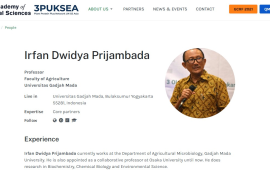
The Faculty of Agriculture, Universitas Gadjah Mada (UGM), continues to strengthen its international research collaborations through participation in the Plant Protein Plus Network UK–Southeast Asia (3PUKSEA). As part of this initiative, Prof. Irfan Dwidya Prijambada from the Department of Agricultural Microbiology, Faculty of Agriculture UGM, took part in a series of academic and industry engagement activities in the United Kingdom in April 2026. The program, titled “Plant Protein Plus Network UK–SE Asia (3PUKSEA): Multi-disciplinary Collaboration for Plant Protein Research and Innovation Network between the UK and Southeast Asia,” focuses on developing sustainable plant-based protein sources through international research partnerships (https://3puksea.io.vn/index.php/news-events/visits-the-uk-2026).
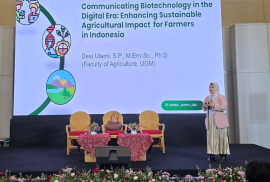
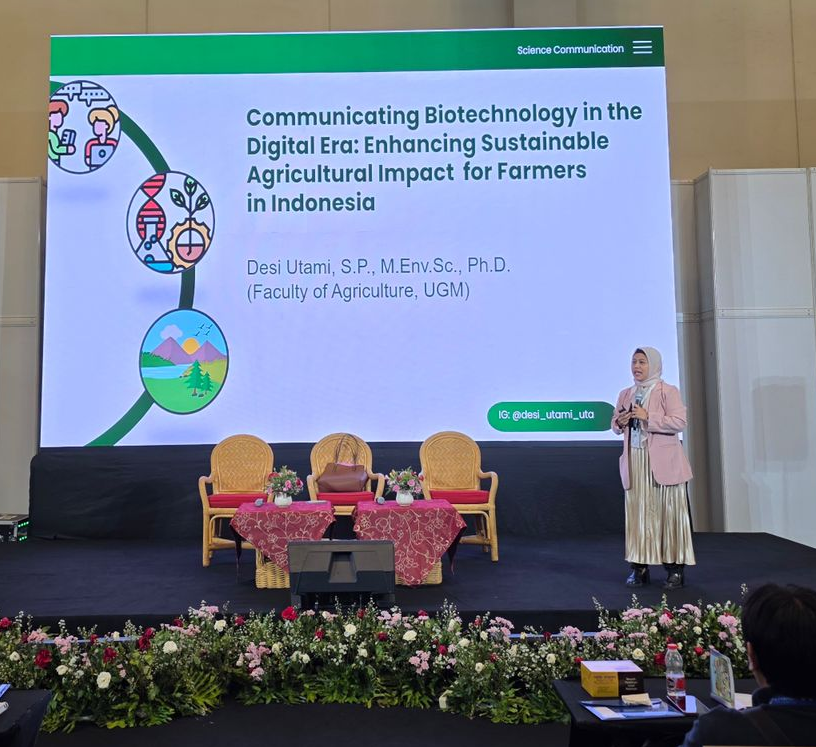
Dr. Desi Utami, a lecturer from the Department of Agricultural Microbiology, Faculty of Agriculture, Universitas Gadjah Mada (UGM), was invited as a speaker at the scientific forum entitled “Harmonized Biosafety Assessment and Sustainable Agriculture: Accelerating Innovation with Impact for Indonesian Smallholders.” The event was organized by CropLife Indonesia in collaboration with the Indonesian Biotechnology Consortium and Lab Indonesia, and was held at ICE BSD City on April 17, 2026.


The rapid advancement of modern biotechnology has opened new opportunities for accelerating livestock breeding programs and improving genetic quality in Indonesia. In support of these developments, Nur Akbar Arofatullah, S.P., M.Biotech., Ph.D., a lecturer in Agricultural Microbiology at the Faculty of Agriculture, Universitas Gadjah Mada (UGM), has been actively involved in discussions and explorations of DNA synthesis (DNA printing) technology and Loop-Mediated Isothermal Amplification (LAMP)-based molecular diagnostic methods together with international industry partners and experts.
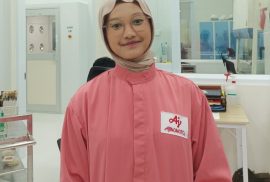
Praharsiwi Nisa Az Zahro, a student of the Agricultural Microbiology Study Program at Universitas Gadjah Mada (UGM), successfully completed her Field Work Practice (Kerja Lapangan/KL) and presented the results through a Field Work Seminar on campus. Her journey began at PT Ajinomoto Indonesia – Mojokerto Factory, one of Indonesia’s largest food manufacturing facilities. During the seminar, she presented the outcomes of her one-month industrial placement and research project entitled “Microbiological Contamination Analysis and Colony Morphological Characterization in a Seasoned Flour Manufacturing Plant at PT Ajinomoto Indonesia – Mojokerto Factory.”
The Faculty of Agriculture at Universitas Gadjah Mada (UGM), through its Agricultural Microbiology Study Program, continues to strengthen international research collaboration through a joint research project with Mitsui Chemicals Crop & Life Solutions (MCCLS) and The University of Osaka, Japan. The project focuses on the development of microorganism-based bioinsecticides as environmentally friendly alternatives for pest management. As an initial step in coordinating the research activities, the first progress report meeting was held online on May 13, 2026, to discuss the preliminary research outcomes and future research plans.
The Faculty of Agriculture at Universitas Gadjah Mada (UGM) continues to encourage students to expand their academic capacity and research experience through various international opportunities. One of these opportunities is participation in overseas research internship programs, which not only broaden scientific perspectives but also strengthen global academic networks and research competencies.

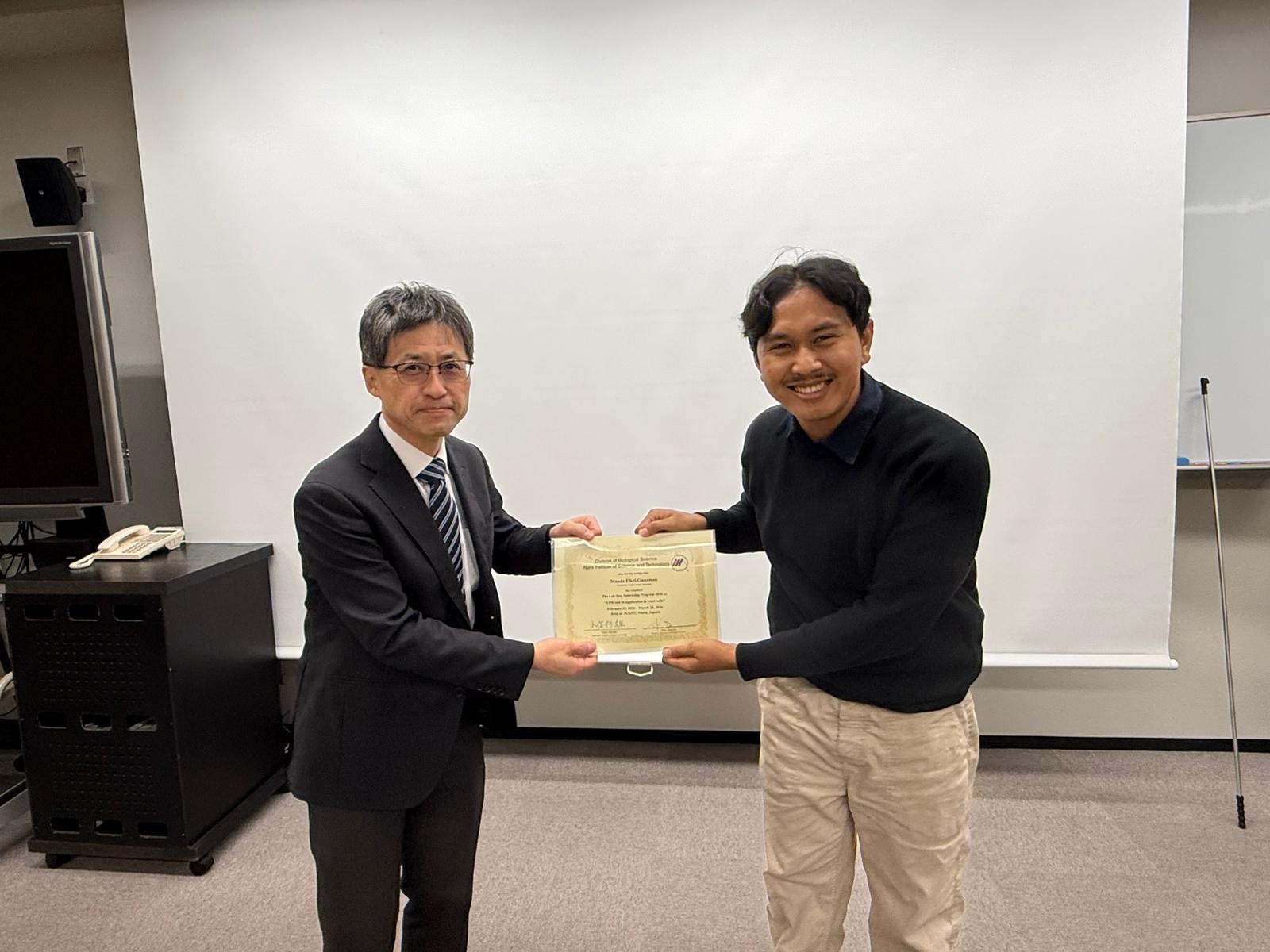
Muadz Fikri Gunawan, a 2021 student of the Agricultural Microbiology Study Program and a 2024 Master’s student in Biotechnology through UGM’s fast-track program, is currently undertaking a research internship at the Nara Institute of Science and Technology (NAIST), Japan. During the internship, Muadz joined the Laboratory of Organelle Control under the supervision of Associate Professor Kimata. His research focuses on the Unfolded Protein Response (UPR) pathway and organelle control mechanisms using Saccharomyces cerevisiae as a model organism. Through this research, he investigates how yeast cells respond to stress and maintain organelle homeostasis under various cellular conditions.
The Agricultural Microbiology Study Program, Faculty of Agriculture, Universitas Gadjah Mada (UGM), continues to expand its international research network through collaborative activities with partner institutions in Japan. One of the lecturers from the Agricultural Microbiology Study Program, who is also affiliated with the Biotechnology Study Program at the UGM Graduate School, Agung Dian Kharisma, Ph.D., received an official invitation from the Nara Institute of Science and Technology (NAIST), Japan, to conduct collaborative research under the NEXUS Young Talents Exchange and Capacity Development Program (Y-tec) supported by the Japan Science and Technology Agency (JST).
Two students from the Department of Agricultural Microbiology, Uways Irfany Adiprawira and Yori Idmaldi Arif, received a valuable opportunity to participate in the Sakura Science Program (SSP) organized by the Japan Science and Technology Agency (JST). Over the course of 12 days, starting on November 4, 2025, they experienced firsthand the academic atmosphere at Ibaraki University, Japan. The program, titled “New Approaches to Disease Control in Tropical Crops,” was not just an ordinary training activity—it was a comprehensive immersion that combined learning, experimentation, and exploration of Japanese culture and technological advancement.