
The Agricultural Microbiology Study Program, Faculty of Agriculture, Universitas Gadjah Mada (UGM), continues to expand its international research network through collaborative activities with partner institutions in Japan. One of the lecturers from the Agricultural Microbiology Study Program, who is also affiliated with the Biotechnology Study Program at the UGM Graduate School, Agung Dian Kharisma, Ph.D., received an official invitation from the Nara Institute of Science and Technology (NAIST), Japan, to conduct collaborative research under the NEXUS Young Talents Exchange and Capacity Development Program (Y-tec) supported by the Japan Science and Technology Agency (JST).

The collaborative research program was conducted from 6–17 April 2026 at the NAIST campus in Nara, Japan. The NEXUS Y-tec Program is an international initiative designed to strengthen young talent exchange, research capacity development, and academic and innovation networks among universities and research institutions across Asia. Through this program, researchers are encouraged to establish long-term collaborations while gaining exposure to advanced research environments and emerging scientific developments.
During the program, participants engaged in collaborative research activities with NAIST researchers, scientific knowledge exchange sessions, and discussions on future research opportunities in biotechnology and life sciences. As part of the program, participants had the opportunity to visit and hold research discussions in three leading laboratories at NAIST: the Plant Developmental Signaling Laboratory led by Prof. Keiji Nakajima, the Plant Immunity Laboratory led by Prof. Yusuke Saijo, and the Plant Regeneration and Morphogenesis Laboratory led by Prof. Momoko Ikeuchi.
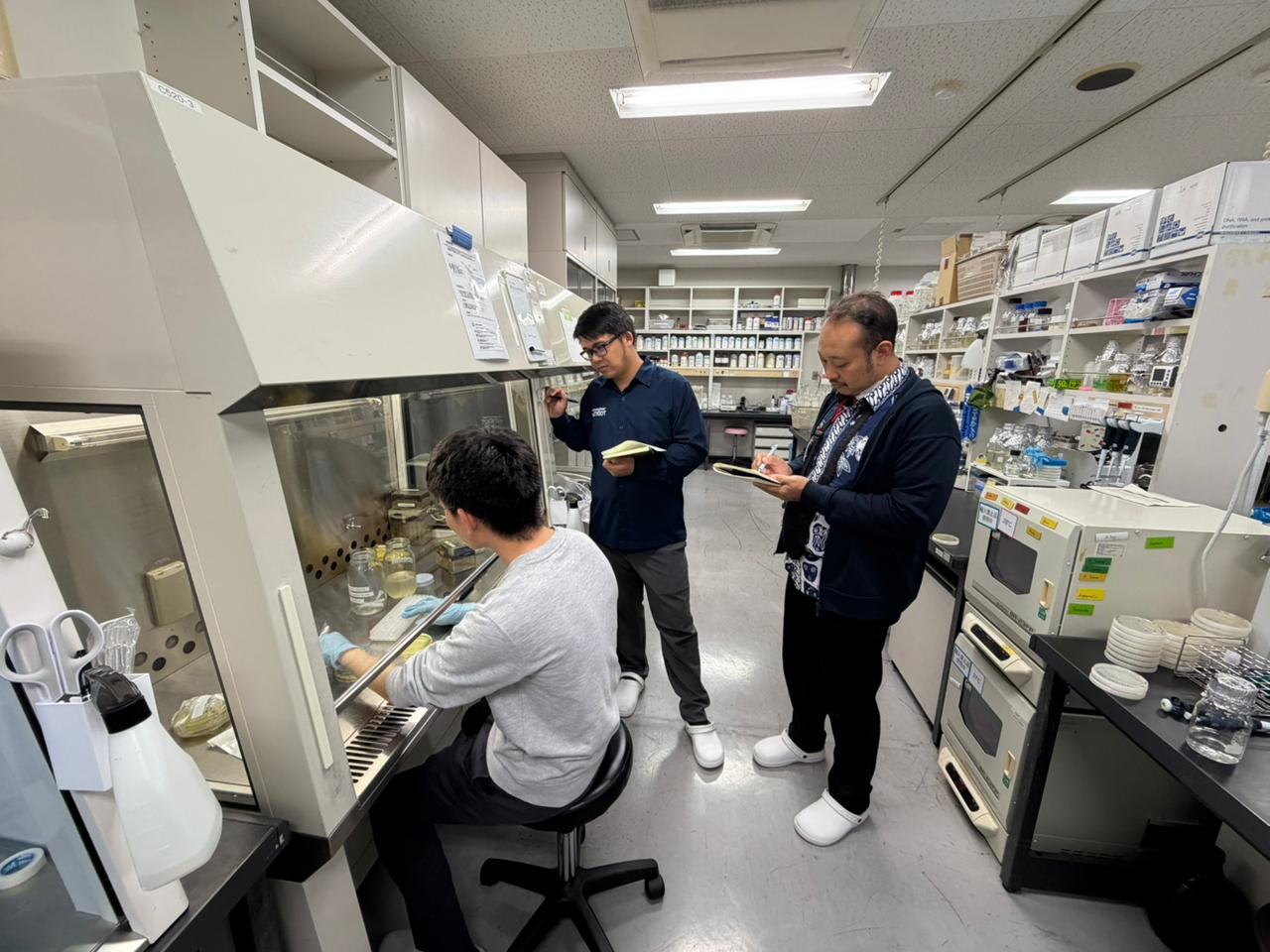
The program provided valuable firsthand exposure to NAIST’s advanced research facilities and cutting-edge technologies, particularly in the fields of molecular biology, plant biotechnology, and life sciences. In addition to discussing ongoing research projects in each laboratory, participants also received information about opportunities to pursue Master’s (M.Sc.) and Doctoral (Ph.D.) studies at NAIST through various international scholarship schemes. These interactions created opportunities to strengthen academic cooperation between UGM and NAIST in both research collaboration and human resource development.
Participation in the NEXUS Y-tec Program is expected to enhance research capacity, expand international collaborations, and open new opportunities for joint innovation and scientific publications in microbiology and biotechnology. The program also reflects the commitment of the Agricultural Microbiology Study Program at UGM to support the internationalization of higher education and the strengthening of global research networks.
Furthermore, the knowledge and experiences gained during the program are expected to be shared with students and academic communities at UGM, particularly regarding opportunities for graduate studies abroad, international research networking, academic culture in Japan, and scholarship opportunities that can support future academic and research careers. Through initiatives such as this, UGM continues to foster globally connected scholars and contribute to the advancement of science and innovation through international collaboration.
This activity contributes to the achievement of SDG 4 (Quality Education), SDG 9 (Industry, Innovation and Infrastructure), and SDG 17 (Partnerships for the Goals).