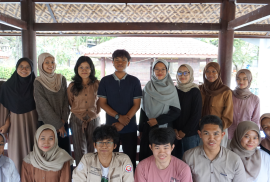
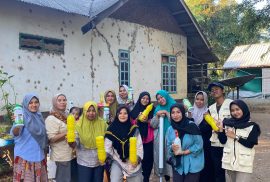
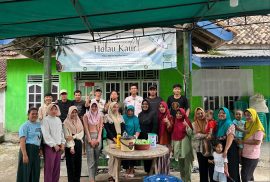
The Community Service-Learning Program (KKN-PPM) Period II 2025 of Universitas Gadjah Mada was carried out by all students of the 2022 cohort across various regions in Indonesia. One of the Agricultural Microbiology students, Selvina Ratna, participated as a member of the Bromo Bestari Team, which conducted community service in Gubugklakah Village, Poncokusumo Subdistrict, Malang Regency, East Java. Through this program, Selvina gained valuable new experiences and had the opportunity to directly apply the knowledge she had acquired during her studies. The KKN location, a village known for its fertile land and as a gateway to Mount Bromo’s tourist route, also provided Selvina with the chance to better understand the local community, cultural activities, and the untapped potential of local resources through interdisciplinary collaboration.
SDG 2: ZERO HUNGER
Yomita Misya, a student of the Agricultural Microbiology Study Program, Faculty of Agriculture, Universitas Gadjah Mada (Faperta UGM), introduced “corn tempeh” as an innovation in local food development in Gedong Jetis Village, Tulung District, Klaten Regency, Central Java. This activity was part of the Community Service Program (KKN-PPM) “Tulang Tulung” Team, which focuses on addressing extreme poverty in the region.
According to the coordinator of the Gedong Jetis subunit, Aldara Fatiyah (Faculty of Social and Political Sciences, 2022), corn is the main agricultural commodity in Gedong Jetis Village.
“There are plenty of cornfields in Gedong Jetis, and the farmers are abundant as well. However, until now the harvest has only been sold as livestock feed without further processing,” she explained.
The Department of Agricultural Microbiology, Faculty of Agriculture, Universitas Gadjah Mada (UGM), has once again achieved an academic milestone through an international scientific publication. On June 29, 2025, a research article titled “Enhanced Biomass Production of Various Aquatic Duckweed Species Through the Inoculation of Plant Growth-Promoting Bacteria” was officially published in the Egyptian Journal of Aquatic Biology & Fisheries, a reputable journal in the field of aquatic biology and fisheries.
The Faculty of Agriculture, Universitas Gadjah Mada (Faperta UGM), in collaboration with Kasetsart University, Thailand, held a guest lecture open to the UGM academic community and the public. The event took place online via Zoom Meeting on Wednesday, June 4, 2025, featuring Dr. Chanita Boonmak from the Duckweed Holobiont Resource and Research Center (DHBC), Kasetsart University, Thailand, as the keynote speaker.
The topic presented in this guest lecture was “Duckweed Microbiome: Unlocking Bacterial Potential for Environmental and Food Applications”, which highlighted research collaboration funded by the Japan Science and Technology Agency (JST) and the Japan International Cooperation Agency (JICA) under the Science and Technology Research Partnership for Sustainable Development (SATREPS) program.
“Microdiscussion: Community Service Program” is a discussion event titled Microdiscussion: Community Service Edition, held on September 8, 2024. The event aims to provide insights to students on various aspects that need to be understood when undertaking a Community Service Program (Kuliah Kerja Nyata or KKN). Participants of this event included Microbiology students from the 2022 and 2023 cohorts. It was held at the Mina Business Incubator (IMB) Restaurant, Faculty of Fisheries, UGM.
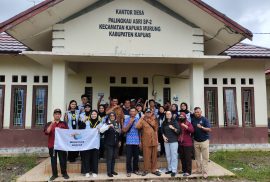
A student from the Agricultural Microbiology Study Program at Gadjah Mada University (UGM) class of 2021, Muhammad Prakosa Damarsejati, participated in the Community Empowerment Service Learning Program (KKN-PPM) for the second period of 2024 in Palingkau Asri Village, Kapuas Murung District, Kapuas Regency, Central Kalimantan. This KKN activity is a mandatory program included in the intramural activities that implement the tri dharma of higher education: education, research, and community service. It provides students with the experience of learning and working in community development activities as a medium for applying and developing science and technology outside the campus, according to the needs of the region, within a predetermined work mechanism.
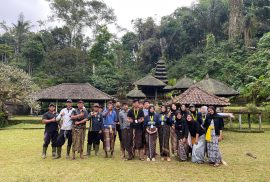
The KKN-PPM program conducted by UGM (Gadjah Mada University) provides an opportunity for agricultural microbiology student, Zikra Fathin Nabila, to broaden her knowledge of national values and diversity. This KKN program was conducted from July to August. For exactly 50 days, Zikra carried out her KKN program in Pelaga Village, a village that is very green, cool, and full of unique Indonesian potential to be proud of. Zikra learned a lot from the community there about social values, nationalism, and diversity. Actively participating in community activities in the village made Zikra proud to be an Indonesian citizen. This KKN activity also became a place for Zikra to learn a lot about practical knowledge directly in the community environment.
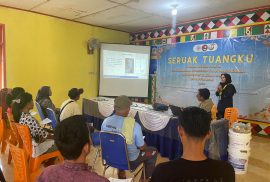
The Community Service-Learning and Community Empowerment Program (KKN-PPM) is a mandatory course for all UGM students. Through this course, students are encouraged to enhance their empathy, multidisciplinary collaboration, and direct contributions to society. The KKN-PPM UGM is conducted across 35 provinces in Indonesia over four time periods. One of the Agricultural Microbiology students from the 2021 cohort, Hafsah Dwi Nur Haliza, commonly known as Lisa, joined unit AC-002 for the second period of 2024 on Tuangku Island. The island is located in Pulau Banyak Barat Sub-district, Aceh Singkil Regency, Aceh Province. Following the recommendation from the Aceh Provincial Bappeda, UGM students from unit AC-002 were directed to carry out their KKN on Tuangku Island, which is part of an archipelago directly bordering the Indian Ocean.
In August 2024, Muhammad Misbahul Anam, a student of the Agricultural Microbiology class of 2021, completed his Community Service-Learning and Community Empowerment Program (KKN-PPM) for the second period of the 2023/2024 academic year in Sugian Village, Sambelia Sub-district, East Lombok Regency, West Nusa Tenggara. The KKN took place from July to August. This KKN activity is one of the compulsory courses that students must participate in. The KKN serves as a platform to apply what has been learned in lectures directly to the community. For Misbah, as the microbiology student is often called, KKN encourages students to connect directly with the community, pushing them, who may have previously been confined to laptops, books, and classroom activities, to immerse themselves in the community, interact directly with residents, solve existing problems, and engage in the surrounding social life. In some scenarios, students may even become involved in those problems, requiring them to solve the issues they face while considering local culture so that the solutions provided by the students can be accepted by the community. The KKN lasted for 50 days. Although it sounds short, Misbah feels that the time was sufficient to provide the experience of living and working directly within the community.
Aloisius Andhika Mahesa Kanigara, a student of the Agricultural Microbiology Study Program from the 2021 cohort, has just completed his Community Service Program (KKN) in Linau Village, Maje Sub-district, Kaur Regency, Bengkulu Province. The KKN program took place from July 1 to August 19, 2024. Andhika and his team applied the knowledge they learned on campus through work programs designed to empower the local community. One of the programs carried out was the production of organic fertilizer using EM4, which is expected to help the people of Linau, most of whom work as fishermen, in improving soil quality and their agricultural yields.