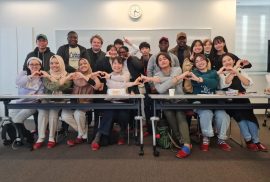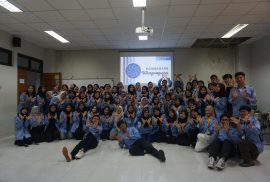
On Sunday, March 3, 2024, the Microbiology Student Association (PERMAHAMI) held the Grand Launching of its new cabinet, named the Wangsaguna Cabinet. The Grand Launching of the Wangsaguna Cabinet was attended by several delegations from student associations of other study programs within the Faculty of Agriculture and the Student Executive Board (BEM KM) of the Faculty of Agriculture. The event took place at Rachmiwaty Building 12.1.1 from 08:00 to 10:00 AM local time. The word “Wangsaguna” itself originates from Sanskrit, consisting of two words, “Wangsa,” meaning Family, and “Guna,” meaning Beneficial. Therefore, the Wangsaguna Cabinet signifies a beneficial family, aiming for PERMAHAMI to become a home for agricultural microbiology students to actualize themselves according to their respective interests, benefiting not only the students but also society. The Grand Launching event also served as the inauguration ceremony for the new PERMAHAMI 2024 board members, inaugurated directly by the Chairperson of the previous period’s cabinet (the Nayakaharsa Cabinet), followed by the introduction of the new work programs of the Wangsaguna Cabinet, embracing the vision of making PERMAHAMI an organization based on family values and beneficial to its members. Various work programs aimed at achieving the Wangsaguna Cabinet’s goals include Study Learning Sessions with Micro (BBM), Microbiology Podcasts (Micropods), Micro Games, Social Sharing and Environmental Care, and many other exciting programs.
SDG 4: PENDIDIKAN BERKUALITAS
The Land of the Rising Sun, Japan, became the first international journey for Zikra Fathin Nabila. More affectionately known as Zikra, a Agricultural Microbiology student Class of 2021, had the opportunity to participate in a student exchange program at one of Japan’s universities, Ibaraki University, during the last semester of 2023/2024. The AIMS (ASEAN Internal Mobility for Students) program provided Zikra with the opportunity to experience studying abroad in a foreign land.
Countless stories marked the beginning of Zikra’s journey before she could finally qualify as a participant in the AIMS program. Feelings of self-doubt, unworthiness, fear of failure, and fluctuating motivation accompanied her first steps in applying for AIMS. Nevertheless, Zikra attempted to surpass all the challenges and limitations she set for herself. There is no harm in trying; the end result will become a story. Failure will become an experience. Success will become a new challenge that needs to be tackled. With determination and preparation, Zikra attempted to apply. Armed with her CV, TOEFL certificate, motivation letter, transcripts for 4 semesters, and several permission letters, she progressed to the first selection stage. It was beyond her imagination, but she passed and proceeded to the interview stage, eventually becoming an AIMS participant.
Three agricultural microbiology students from the 2021 class, Fathia Thaurika Rahma, Ani Fajar Dwi Sawitri, and Shinta Firdha Amalia, conducted Field Work (KL) at PT Industri Jamu dan Farmasi Sido Muncul Tbk from January 2nd to January 26th, 2024. The reason they chose PT Industri Jamu dan Farmasi Sido Muncul Tbk as their Field Work location is based on their interest and passion in the field of traditional medicine and pharmacy industry. Additionally, PT Industri Jamu dan Farmasi Sido Muncul Tbk is an internationally scaled company, so they believe that Sido Muncul can provide valuable knowledge and experience that they have not obtained before.
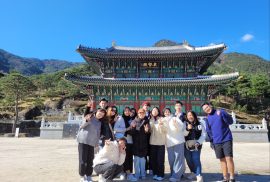
The student exchange program of the Faculty of Agriculture, UGM, at Gyeongsang National University (GNU), Jinju, South Korea, is facilitated by the Asian International Mobility for Students (AIMS) program. Representing the AIMS GNU Fall Semester 2023 exchange students are Sausan Syadzafie Shafar, commonly known as Sausan, along with another student from the Faculty of Agriculture, UGM. The student exchange period at GNU was spent amidst the transition from cool late summer to windy autumn and early bone-chilling winter. Experiencing a temperate climate is certainly not common in tropical climates like Indonesia, making this student exchange opportunity highly valuable. The different climate also brings about a diverse biodiversity found in South Korea, which is quite different from Indonesia, presenting an intriguing aspect for a student of the Faculty of Agriculture. Classroom and extracurricular activities provided excellent opportunities to understand the essence of student life and South Korean society.
Pradipta Guntur Putra, a 2019 Agricultural Microbiology student affectionately known as Dipta, has just completed his undergraduate research in Japan. This research was conducted at the Laboratory of Food, Life, and Environmental Science, Faculty of Agriculture (農学部), Yamagata University (山形大学), under the guidance of Prof. Toru Watanabe, Ph.D. His research titled “The Analysis of Functional Genes and Microbial Community Relevant to CH4 and N2O emission in Dent Corn Fields” was successfully completed and presented at the Joint Seminar, Eco-Science Course, Yamagata University, on August 7, 2023.
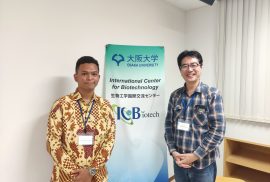
One of the Microbiology students from the 2020 cohort had the opportunity to participate in the “Sakura Science Exchange Program”. Arya Dharma Sanjaya, commonly known as Arya, was granted a golden opportunity to join the Sakura Science Exchange Program at Osaka University from October 22nd to October 28th, 2023. According to Arya, this program was not just an ordinary journey but his first trip abroad. The International Center for Biotechnology at Osaka University served as the venue for this adventure. In this program, Arya not only explored the academic world but also interacted with fellow exchange students from various countries. One interesting aspect of Arya’s experience in Osaka was the variety of activities organized. Firstly, there was an orientation session about the campus environment, where Arya was introduced to the advanced learning facilities. The well-organized campus provided an insight into Japan’s excellent higher education system.
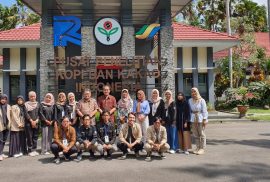
Students from the Department of Agricultural Microbiology, Fika Tri Andaini (2020) (Fika) and Nur Afni Febriyani (2020) (Afni), had the opportunity to participate in the Merdeka Belajar Kampus Merdeka (MBKM) program in the form of Internship Learning Activities (MBKM-Internship) at the Coffee and Cocoa Research Center (PUSLITKOKA) from February 6, 2023, to June 16, 2023, precisely in their 5th semester. During their MBKM at PUSLITKOKA, Fika was placed in the Plant Disease and Pest Laboratory, while Afni was in the Plant Protection Laboratory. The MBKM-Internship program undertaken by Fika and Afni was equivalent to more than 20 credits in one semester. The courses equivalent for Fika and Afni had some differences, depending on the laboratory where they were placed. For Fika, there were 11 equivalent courses, including Microbial Development, Production, and Utilization; Soil Microbes; Pest and Disease Control; Development of Biological Agents; Identification of Pests and Diseases; Processing of Agricultural/Plantation Products; Quality Control and Quality Assurance of Agricultural/Plantation Products; Managerial Behavior; Field Work (KL); Seminar; and Leadership, while for Afni, there were also 11 equivalent courses, but there were 5 courses different from those taken by Fika, including Communication Skills; Processing of Agricultural/Plantation Land Fertility; Development, Production, and Utilization of Beneficial Microbes; Fundamentals of Coffee Biotechnology; and Fundamentals of Cocoa Tissue Culture.
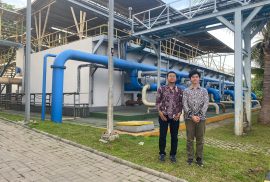
Cokorda Keigoputra Pemayun (2021) (Keigo) and Chandra Rizqullah Triananda (2021) (Chandra) conducted their Field Work (KL) activities at PT MOYA Tangerang, a subsidiary of PT MOYA Indonesia, which is one of the largest private companies in clean water processing in Indonesia. The KL activities took place from December 27, 2023, to January 26, 2024. During the first week, the students were introduced to the company in general and learned simple water sample analysis methods. Keigo and Chandra used this time to understand the company’s situation and culture. In the following weeks, there were daily analysis activities, networking, processes, biweekly tasks, and data verification with PDAM as a cooperative partner. The third and fourth weeks were the busiest times during the KL implementation, due to water processing projects involving nanobubble and ozone equipment. They found the working atmosphere at PT MOYA Tangerang very comfortable because they were given the opportunity to participate directly in several projects, and the laboratory infrastructure facilities were excellent.
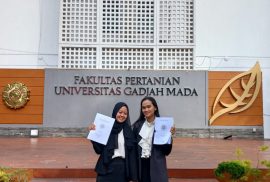
In the Judiciary Events of periods 1 and 2 in January 2024, the Department of Agricultural Microbiology graduated two students with the fastest study period, namely Roihana Ifa Kamalia (2020), commonly known as Ifa, with a study duration of 3 years 4 months 9 days, and Daniella Atteke Cantika Putri, commonly known as Cantika, with a study duration of 3 years 4 months 17 days. Ifa and Cantika started their microbiology studies during the COVID-19 pandemic with fully online lectures until the third semester. According to them, the strategy they applied to complete their studies on time was setting academic targets, especially for Field Work, Seminars, and Theses, along with strict time discipline. They always documented their academic targets, such as starting to draft fieldwork proposals during the 4th semester break so that they could conduct Field Work during the 5th-semester break in January 2023. They also conducted their fieldwork simultaneously with writing the final reports, allowing them to present their Field Work Seminar in March 2023.
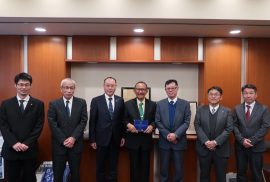
On January 19, 2024, one of the professors from the Department of Agricultural Microbiology, Prof. Ir. Irfan Dwidya Prijambada, M.Eng., Ph.D., was awarded the title of Osaka University Global Alumni Fellow. He had previously been appointed as a Collaborative Professor at the same university since 2015 until now to teach about traditional fermentation. The title of Osaka University Global Alumni Fellow was directly conferred by the Executive Vice President of Osaka University, Manabu Tanaka. This title is bestowed upon Osaka University alumni who are active in the field of international networking. During the award ceremony, Tanaka expressed his hope that Prof. Irfan would continue to serve as a bridge between Osaka University and Indonesia in the development of research and strengthen relations among Osaka University alumni active in Indonesia.