Universitas Gadjah Mada (UGM) has once again deployed students through the Community Service and Community Empowerment Learning Program (KKN-PPM) Period II of 2026 as part of the university’s commitment to supporting community development through science-based approaches. One of the KKN units, supervised by Nur Akbar Arofatullah, S.P., M.Biotech., Ph.D., a lecturer at the Department of Agricultural Microbiology, Faculty of Agriculture, UGM, will conduct its community engagement activities in Padaherang Village and Paledah Village, Padaherang District, Pangandaran Regency, West Java.
SDG 8: DECENT WORK AND ECONOMIC GROWTH
Thousands of students from Universitas Gadjah Mada (UGM) have officially begun their community engagement journey through the Community Service and Community Empowerment Learning Program (KKN-PPM) Period II of 2026. Following the official deployment ceremony conducted by the university, students were dispatched to various regions across Indonesia to implement community empowerment programs for approximately 50 days.
One of the KKN units assigned to the Province of West Nusa Tenggara will carry out its activities in Kuta Village and Mertak Village, Pujut District, Central Lombok Regency. The unit is supervised by Susanti Mugi Lestari, S.P., M.Si., Ph.D., a lecturer at the Department of Agricultural Microbiology, Faculty of Agriculture, Universitas Gadjah Mada.
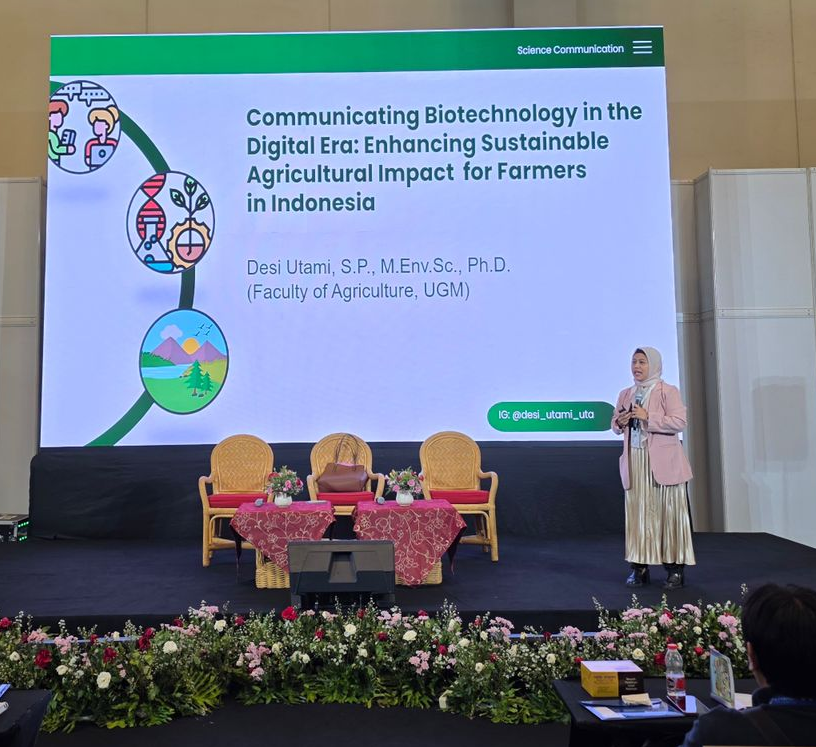
Dr. Desi Utami, a lecturer from the Department of Agricultural Microbiology, Faculty of Agriculture, Universitas Gadjah Mada (UGM), was invited as a speaker at the scientific forum entitled “Harmonized Biosafety Assessment and Sustainable Agriculture: Accelerating Innovation with Impact for Indonesian Smallholders.” The event was organized by CropLife Indonesia in collaboration with the Indonesian Biotechnology Consortium and Lab Indonesia, and was held at ICE BSD City on April 17, 2026.

Amalia Putri Sholikhati was recognized as the Best Graduate of the Department of Agricultural Microbiology during the Undergraduate Graduation Ceremony for Period III of the 2025/2026 Academic Year at the Faculty of Agriculture, Universitas Gadjah Mada (UGM), held at Prof. Harjono Danoesastro Auditorium on May 21, 2026. She completed her undergraduate studies with a cumulative GPA of 3.52, while also achieving numerous academic and extracurricular accomplishments throughout her time at the university.
The Department of Agricultural Microbiology held a student evaluation meeting on Wednesday, January 28, at 9:00 a.m., located at the Agricultural Microbiology Department Library, 4th floor of the AGLC Building. The meeting was attended by Agricultural Microbiology students from the 2019 and 2020 cohorts, along with the Head of Department, Mr. Saifur, and the Head of the Study Program, Ms. Desi. This activity served as an open forum between the department and students to discuss academic progress and challenges encountered during their studies.
The Department of Scientific Affairs, in collaboration with the Department of Entrepreneurship of the Association of Agricultural Microbiology Students (PERMAHAMI), Faculty of Agriculture, Universitas Gadjah Mada, successfully held the Microbiome Creation Product (MCP) 2025 event on Saturday, 25 October 2025. Held at the Integrated Laboratory of the Agrocomplex, Faculty of Agriculture UGM, this event carried the theme “The Power of Probiotics: From Fermentation to Innovation”, aimed at enhancing participants’ understanding of the role of microorganisms in food production and providing hands-on experience in producing a fermented product—yogurt. The program featured lectures, a talk show, and a practical yogurt-making session as a form of educational outreach on fermentation science and its business potential.
The Student Resource Development Department (PSDM) together with the PERMAHAMI Executive Board successfully organized the PERMAHAMI Writing Program 2025 on Sunday, August 31, 2025, from 08.00 to 14.00 WIB. This program was designed as a solution to the challenges faced by students in academic writing, particularly in finding reliable and relevant scientific journals, citing sources properly, and compiling bibliographies according to the Faculty of Agriculture’s thesis writing guidelines.
The event began with an introduction to the department and study program delivered by the Head of Department and the Head of the Microbiology Study Program. It was then followed by a session with invited speakers, covering effective strategies for finding scientific journals, proper citation techniques, the structure of laboratory reports, and the correct way to compile bibliographies in accordance with academic rules.
The Faculty of Agriculture, Universitas Gadjah Mada (UGM) once again carried out a community service program by introducing an innovation in the use of fermented duckweed (Lemna sp.) as feed for fish and livestock. The activity was held at the Al-Dzikro Orphanage Foundation, Imogiri, Bantul, as an effort to promote food self-sufficiency while also encouraging productive economic enterprises within the orphanage.
Duckweed, or kiambang, is a high-protein aquatic plant with great potential as an alternative feed source. Through the fermentation process, the nutritional value of duckweed can be enhanced and its digestibility improved, thereby not only reducing feed production costs but also opening new business opportunities based on local resources.
The Community Service and Empowerment Program (KKN-PPM) Period II 2025 of Universitas Gadjah Mada was successfully carried out by one of the Agricultural Microbiology students of the 2022 cohort, Ilyasa Ilham, for 50 days from June 20 to August 8, 2025 in Silaut Subdistrict, Pesisir Selatan Regency, West Sumatra. KKN-PPM is a compulsory course that enables students to directly apply their academic knowledge within society. Through this program, students are encouraged to live among the community while making tangible contributions to both the prevention and resolution of local challenges.
An environmentally friendly technology-based empowerment program has been successfully carried out by Agricultural Microbiology student of the 2022 cohort, Elnadya Karina Cahya Murti, over a period of 50 days to optimize the abundant local resources. Elnadya was accompanied by the KKN-PPM Junjung Pulau Besar team, Period II of 2025, in Sumber Jaya Permai Village, South Bangka Regency, Bangka Belitung Islands.
To enhance sustainable agricultural and livestock productivity, Elnadya focused her program on the application of microbiological knowledge. The work programs included producing cocopeat planting media from coconut husk waste through microbial fermentation, education and application of mycorrhizal propagules on corn seeds, and the utilization of briquettes made from cattle manure as an alternative energy source.