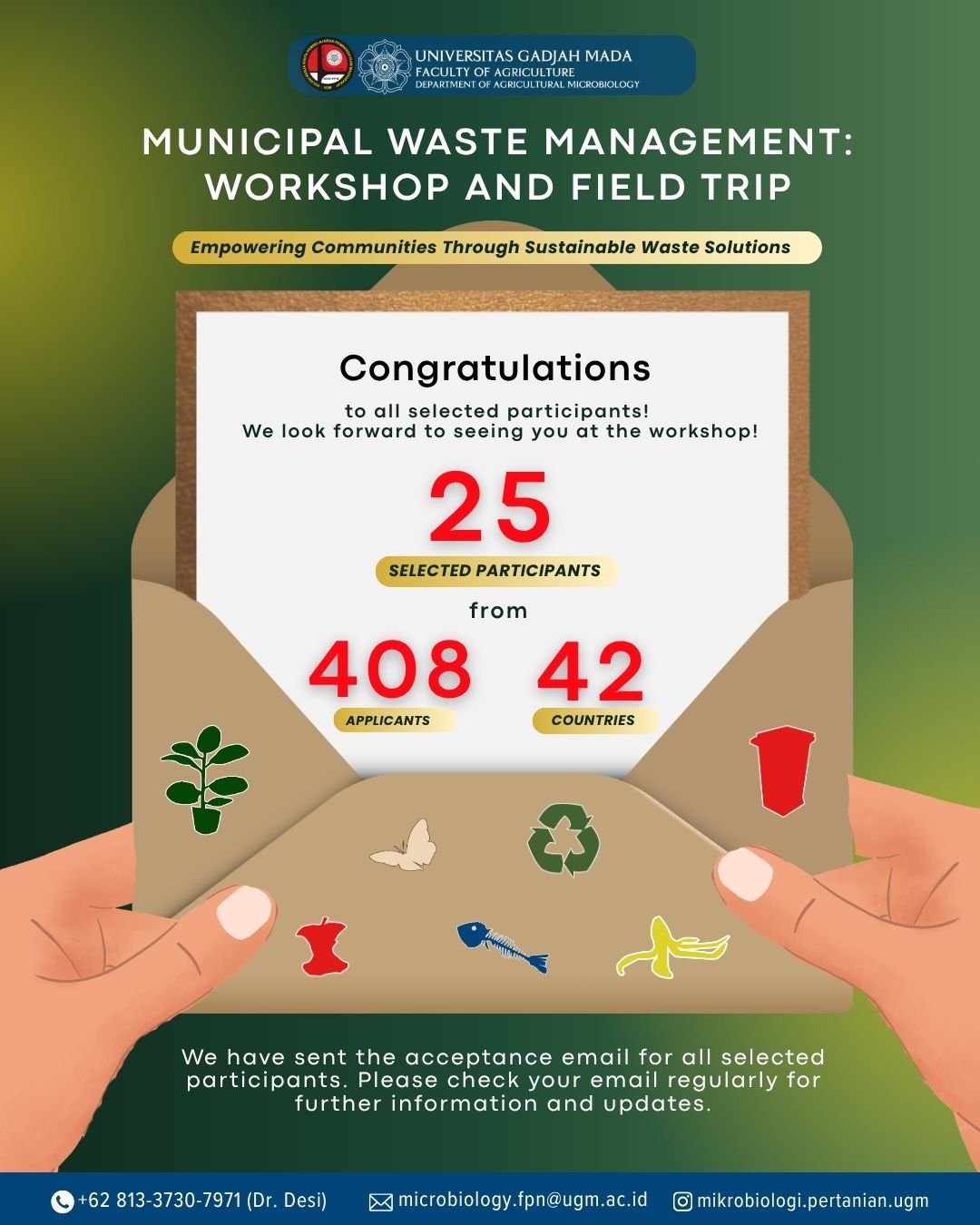
The Faculty of Agriculture, Universitas Gadjah Mada (UGM), through the Department of Agricultural Microbiology, is once again offering an opportunity for international students to participate in the Municipal Waste Management: Workshop and Field Trip 2026 program. This program is part of the implementation of UGM’s Community Service Program (Kuliah Kerja Nyata/KKN), which promotes a collaborative approach involving academics, international students, and local communities in supporting sustainable community-based waste management. The international program will be held from 20–26 July 2026 in Yogyakarta, Indonesia, under the theme “Empowering Communities Through Sustainable Waste Solutions.”
SDG 4: QUALITY EDUCATION

The rapid advancement of modern biotechnology has opened new opportunities for accelerating livestock breeding programs and improving genetic quality in Indonesia. In support of these developments, Nur Akbar Arofatullah, S.P., M.Biotech., Ph.D., a lecturer in Agricultural Microbiology at the Faculty of Agriculture, Universitas Gadjah Mada (UGM), has been actively involved in discussions and explorations of DNA synthesis (DNA printing) technology and Loop-Mediated Isothermal Amplification (LAMP)-based molecular diagnostic methods together with international industry partners and experts.
The Faculty of Agriculture at Universitas Gadjah Mada (UGM) continues to support students in gaining meaningful learning experiences beyond the classroom through direct engagement with communities. One example is student participation in the SUIJI Service Learning Program (SUIJI-SLP), an international exchange program that combines academic learning, field observation, problem-solving, and cross-cultural exchange through a service-learning approach.

Muhammad Syahru Ramadhan, a student of the Faculty of Agriculture UGM, had the opportunity to participate in the SUIJI-SLP program, which brought together students from various universities in Indonesia and Japan. The program involved participants from UGM, IPB University, Hasanuddin University, and Kagawa University in Japan. Through this exchange experience, Syahru gained valuable insights from academic activities, community observations, and collaborative problem-solving initiatives. According to him, every activity within the program was meaningful and impactful because SUIJI-SLP emphasizes learning through direct community engagement. “During the exchange program, I gained many valuable experiences, ranging from learning activities to problem-solving processes. In my opinion, every agenda in SUIJI-SLP felt meaningful and beneficial because the program focuses on Service Learning,” said Syahru.
The Faculty of Agriculture at Universitas Gadjah Mada (UGM) continues to encourage students to broaden their academic perspectives, cultural understanding, and international networks through various student mobility programs. One such opportunity is the Asian International Mobility for Students (AIMS) Programme, a student exchange initiative under the coordination of SEAMEO RIHED that involves partner universities across Asia, including Universitas Gadjah Mada.

Nabilah Salma Jamaludin, a 2022 student of the Agricultural Microbiology Study Program, had the opportunity to participate in the AIMS Program at Ibaraki University, Japan. The program lasted approximately four months, from mid-September until the end of January. Through this experience, students not only attended academic courses but also gained research experience, cultural adaptation skills, and valuable interactions within an international academic environment.
Praharsiwi Nisa Az Zahro, a student of the Agricultural Microbiology Study Program at Universitas Gadjah Mada (UGM), successfully completed her Field Work Practice (Kerja Lapangan/KL) and presented the results through a Field Work Seminar on campus. Her journey began at PT Ajinomoto Indonesia – Mojokerto Factory, one of Indonesia’s largest food manufacturing facilities. During the seminar, she presented the outcomes of her one-month industrial placement and research project entitled “Microbiological Contamination Analysis and Colony Morphological Characterization in a Seasoned Flour Manufacturing Plant at PT Ajinomoto Indonesia – Mojokerto Factory.”
The Faculty of Agriculture at Universitas Gadjah Mada (UGM) continues to encourage students to expand their academic capacity and research experience through various international opportunities. One of these opportunities is participation in overseas research internship programs, which not only broaden scientific perspectives but also strengthen global academic networks and research competencies.

Muadz Fikri Gunawan, a 2021 student of the Agricultural Microbiology Study Program and a 2024 Master’s student in Biotechnology through UGM’s fast-track program, is currently undertaking a research internship at the Nara Institute of Science and Technology (NAIST), Japan. During the internship, Muadz joined the Laboratory of Organelle Control under the supervision of Associate Professor Kimata. His research focuses on the Unfolded Protein Response (UPR) pathway and organelle control mechanisms using Saccharomyces cerevisiae as a model organism. Through this research, he investigates how yeast cells respond to stress and maintain organelle homeostasis under various cellular conditions.
The Agricultural Microbiology Study Program, Faculty of Agriculture, Universitas Gadjah Mada (UGM), continues to expand its international research network through collaborative activities with partner institutions in Japan. One of the lecturers from the Agricultural Microbiology Study Program, who is also affiliated with the Biotechnology Study Program at the UGM Graduate School, Agung Dian Kharisma, Ph.D., received an official invitation from the Nara Institute of Science and Technology (NAIST), Japan, to conduct collaborative research under the NEXUS Young Talents Exchange and Capacity Development Program (Y-tec) supported by the Japan Science and Technology Agency (JST).
The Department of Agricultural Microbiology held a student evaluation meeting on Wednesday, January 28, at 9:00 a.m., located at the Agricultural Microbiology Department Library, 4th floor of the AGLC Building. The meeting was attended by Agricultural Microbiology students from the 2019 and 2020 cohorts, along with the Head of Department, Mr. Saifur, and the Head of the Study Program, Ms. Desi. This activity served as an open forum between the department and students to discuss academic progress and challenges encountered during their studies.
The Department of Agricultural Microbiology, Faculty of Agriculture, Universitas Gadjah Mada (UGM), held the Year-End Gathering of Agricultural Microbiology on Tuesday, 31 December 2025, at the Integrated Agrocomplex Laboratory, 1st Floor, Faculty of Agriculture UGM. The event commenced at 1:00 PM WIB and was attended by all lecturers as well as research students of the Department of Agricultural Microbiology who are currently conducting their undergraduate thesis research.
This year-end gathering was organized as a moment of togetherness as well as a reflection on the Department of Agricultural Microbiology’s journey throughout 2025. The event also served as an occasion to bid farewell to two staff members of the Department of Agricultural Microbiology who had completed their terms of service, as a form of appreciation for their dedication, contributions, and service to the department.
The Department of Agricultural Microbiology, Faculty of Agriculture, Universitas Gadjah Mada (UGM), held a graduation assessment (yudisium) on Wednesday, December 24, 2025, at the Library of the Department of Agricultural Microbiology, AGLC Building, 4th Floor. The event took place from 1:00 to 2:00 p.m. WIB and was attended by all lecturers of the Department of Agricultural Microbiology.
On this occasion, one student was officially declared to have graduated, namely Muhammad Prakosa Damarsejati. During the event, Dr. Ngadiman delivered words of advice (unen-unen) to the graduate. He emphasized that graduation is not the end of the learning process, but rather the beginning of greater responsibility within society. Graduates are expected to apply their knowledge of microbiology wisely, adaptively, and responsibly, while continuing to develop themselves in line with the dynamics of scientific advancement and societal needs.